Tuesday, August 28, 2018

OUTDOOR PORTRAITS OF AN ARTIST ON LOCATION IN FREAK ALLEY


Here in downtown Boise, Idaho, we have a rare gem called Freak Alley. it’s the largest outdoor art gallery in the Northwest. It spans two streets (a block long) in the alley and parking lots for several small businesses. Some of the work, by the 90 artists this year that were accepted, could be called artistic graffiti, but many of the paintings are true art and some are complex murals two stories high. 

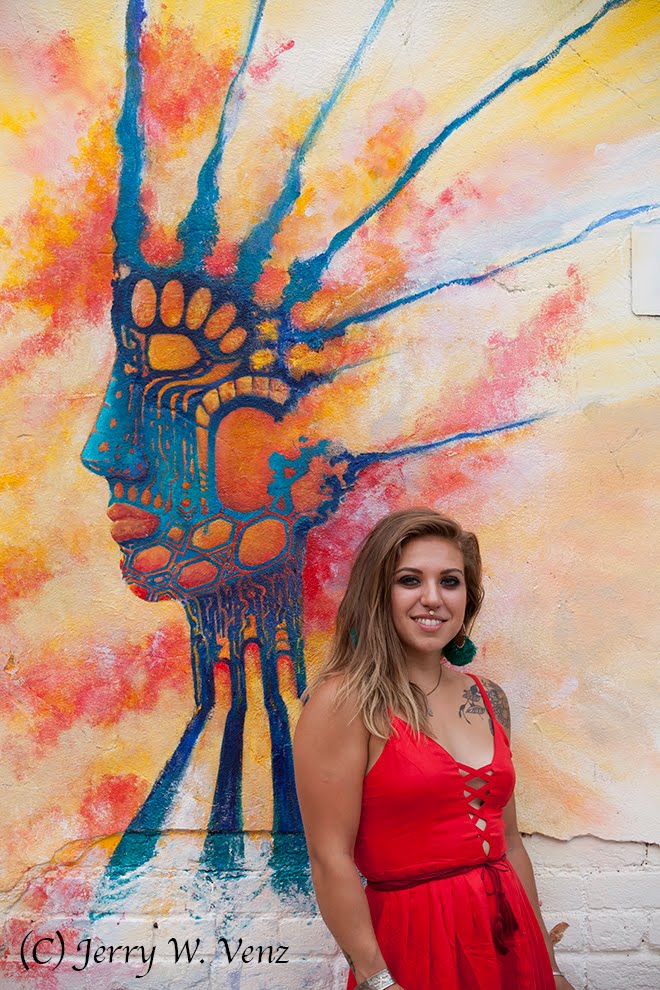
This year my wife and I hosted one of the artists, visiting from Utah, while she worked on her art piece. Her name is Megan Utley and while going to college in Utah, she worked various jobs and does her art part time. While she was with us for just over a week, she worked a couple of construction jobs during the day and then worked waitressing at nights! Some how she managed to do her Freak Alley art piece around work and socializing—sometimes painting all night; camping out IN Freak Alley!

Here’s Megan with her art at the opening night event…
f4.5 @ 1/160 sec., ISO 800; Lens @ 100mm
I think her art piece is one of the best in this year’s Freak Alley exhibition. It’s definitely Not graffiti.


I had to work fast since it a was 8:30pm when Megan got there (after working all night and through the day to finish) when I started; the sun had already set so I was starting at 800 ISO and I wanted to give her multiple poses.


This is the poise I had pre-visualized doing after Megan had shown me the original of this art piece. It was her favorite in this set.

I finished with her turning her face to me with a smile and zooming out to show her tattoo. Looking good Megan!  It was a pleasure having you in our home and getting to know you and your dog Sam.

’Til next week….as usual ask if you have questions…

Author:  Jerry W. Venz, PPA Master Photographer, Craftsman
Training site: http://www.LightAtTheEdge.com
Client site: http://www.TheStorytellersUsa.com 

Tuesday, August 21, 2018

PHOTOGRAPHY IN LOW LIGHT AND DYNAMIC RANGE


The first time I photographed a Japanese Tea Ceremony was in 2004 at the Hakone Japanese Gardens in Saratoga, California. At the time I knew nothing about this ceremony, so I just photographed the moments that looked interesting. I had no idea it would take so long or could be so complex just to make some tea! 

At that time in my career, as a professional photographer, I was using the second generation of digital camera (the Fuji Fine Pix S-2 Pro). So, when I encountered scenes with very low light I used the camera in B&W mode to maintain quality images. Back then digital cameras were very noisy at any ISO’s 400 and beyond if even slightly under exposed. They were particularly ghastly in color due to “color noise”. This tea ceremony was in very low light and even at ISO 400 I used fill flash at 1/30 second. As the ceremony wound down I turned the flash off and went to ISO 800 and 1600 at 1/15 second. 


f6.7 @ 1/15 sec., ISO 800; Lens @ 153mm
When she turned to the audience and paused, at the end of the ceremony, the directional light on her hands was great. Quickly going to 800 ISO gave me a hand-holdable 1/15 sec. to capture this dramatic image. I don’t know that today I could have captured this scene any better using my 2018 DSLR.

Some more B&W jpegs straight out of the camera….

 f4.8 @ 1/30 se.c, ISO 400 with Flash Fill
I’m still amazed how good these B&W images look using my 2nd generation digital camera from 14 years ago.

f4.8 @ 1/30 sec., ISO 400 with Flash Fill
These fill flash images look this good because we were using the new (back then!) Gary Fong lightsphere flash diffusers on our on-camera flash. 

FLASH FORWARD FOUR YEARS (2008)

Four years later digital cameras have advanced significantly. I now have two of the Fuji FinePix S-3 Pros (we always bought two at a time; and since I was on the Fuji Talent Team, we got our cameras direct from Fuji USA at cost! The Fuji FinePix S-3 Pro had their unique Super CCD SR sensor that expanded the cameras’s dynamic range to 13.5 EVs; the highest scoring dynamic range of ANY camera, when it came out in 2004. In fact, to date (2018) it’s still one of the highest scoring cameras (DXOmark.com) for dynamic range; the top cameras are currently scoring around 14.5 EVS.

So, going back to the Hakone Japanese Gardens for one of their annual events (the Matsuri 2008) I was ready to try that Low Light Tea Ceremony again, this time using my Fuji S-3 Pro.

This time I kept my camera in color mode…

f2.8 @ 1/45 sec., ISO 800; No Flash
This scene would be difficult for a lot of todays digital cameras! The girl is in white in a dim environment and there’s that window with direct sun falling on greenery outside. This is a very high dynamic range scene.  With the Fuji Pro S-3 set to Wide Dynamic Range the girls white kimono has excellent detail and you can actually see detail in the outside greenery,. No other cameras in 2008 could do that; they would just record the window a pure white and clip the highlights in her kimono. In fact, most cameras today would do poorly with this type of scene.

Here’s another from that scene…

 f2.8 @ 1/45 sec., ISO 800; No Flash
These images were shot as JPEGS and because of the low light I used ISO 800 to be able to hand hold my camera. What makes the resulting image quality still more remarkable is that digital cameras have Less dynamic range as the ISO goes up (along with more noise). That’s why most professional photographers try to keep their ISO’s down to 100 to 200 ISO; that’s where most cameras have their highest dynamic range. Well the Fuji S-3 and later S-5 cameras had better dynamic range at 800 ISO (13 EVS!) than most cameras do at 100 ISO.

So, when evaluating your next camera purchase the camera does matter, the sensor size matters, how it handles dynamic range matters, along with ISO noise and your skill with analyzing your subject all matter. Have questions, don’t hesitate to ask…’Til next week.

Author: Jerry W. Venz, PPA Master Photographer, Craftsman 
Training Site: http://www.LightAtTheEdge.com
Client Site: http://www.TheStorytellersUsa.com

Tuesday, August 14, 2018

WEDDING PHOTOGRAPHY IN LOW LIGHT; Part 2 RECEPTIONS


In Part 1 I stressed that I preferred to use natural light or the artificial ambient light on my wedding locations while denigrating photographers who used flash too much. That’s not to say that I do’t use flash at weddings; on the contrary I’ve always had a flash mounted on Both of the cameras around my neck when on the job. Even back in our medium format film days I had a sizable investment in flash rotating brackets and Metz 45 CL4’s on each camera. But if I had some nice directional natural light (say at a window) or a combination of natural and some artificial light, giving me contrasting color temperatures I jumped at it!

The area where we’re most often using flash is at the wedding reception—especially when the reception is at an indoor venue or a nighttime event outside. Under these conditions flash is vital when doing the various action events at the reception…
f2.8 @ 1/50 sec., ISO 800; Lens @ 50mm
In this image of our bride and groom rocking-out at their outdoor reception the lighting was typically worse than at an indoor venue. In this situation I would use my on camera flash equipped with a Gary Fong Lightsphere diffuser as my key and have a radio-controlled flash putting some light in the background. We used this same technique when doing the action images of the garter and bouquet toss. 

Our cake portraits were done very differently….

f5.6 @ 1/15 sec., SIO 800
Because our subject is static we can now be locked-down on a tripod. That means we can use whatever shutter speed and ISO combination to create dramatic lighting using the artificial reception lights or in this case that great window lighting from camera right. We waited until the sun had set giving us a nice exposure for the outdoor background while  the 800 ISO and 1/15 second shutter speed got me what I needed to record those candles.

Using a similar technique on a large interior…

f4.8 @ 1/45 sec., ISO 800; Lens @ 20mm
We always liked to get nice images of the decorated reception site before it was filled with people. Again, I used my ISO to get me to an exposure to balance the interior with the scene out those windows. When you’ve got a scene like that out those huge windows you must avoid blowing out (clipping) the outside part of the image!

Again, like the previous image timing is important in this type of image. Even though this was taken in the early evening because this wedding site (Nestledown, Los Gatos, California) is in the Santa Cruz mountains, surrounded by redwoods, the light fades quickly because it’s so sheltered.

Again, using my ISO to get the image….

f2.8 @ 1/80 sec., ISO 3200; Lens @ 22mm
The table decorations were always a priority at the reception as well. This was also an outdoor reception and I’ve always been a sucker for those little white lights placed in trees or gazebos, so I picked a table where I had those lights in the background. Because the only lights in this scene were those three votive candles and the lights in the background I had to go to ISO 3200 @ f2.8 to do this hand held.

Our bride and groom’s final image of the evening….

 f2.8 @ 1/15 sec., Iso 400; Lens @ 42mm
This couple’s reception was in a huge god-awful tent, so for their final portrait I took them outside dragging them over to these nice trees decorated with my favorite lights! However, these lights were not adequate to illuminate my couple (most of the lights are behind them) so I turned to my on-camera flash and equipped with my handy-dandy Gary Fong, Lightsphere, diffuser I got the soft, subtle, light I wanted to make this look like the only lights in the scene were those tree lights!

Oh, and by the way, I have Not been paid to endorse the Fong Lightsphere or any other equipment I’ve talked about in my blogs.  It’s just stuff I have found that works and I use.

As usual, don’t hesitate to ask questions or make comments related to this blog. ’Til next week…

Author: Jerry W. Venz, PPA Master Photographer, Craftsman
Training site: http://www.LightAtTheEdge.com
Client site: http://www.TheStorytellersUsa.com
Tuesday, August 7, 2018

WEDDING PHOTOGRAPHY IN LOW LIGHT; Part 1


Low or poor light is just part and parcel of wedding photography. As a professional it’s our job to find good light or provide it—and if we can’t solve any lighting problem in 2 to 5 minutes (We rarely got that 5 minutes!) then that’s just our BAD!

My artistic philosophy has always been, by default, to use the natural or artificial ambient light in most wedding scenes as my base and ONLY add light when absolutely necessary. Too many wedding photographers add flash all the time giving the wedding a sameness of look and an unnatural quality that robs the wedding locations of their inherent character.

Now wether this is because these wedding “flashers” are uneducated in the art of lighting or just plain lazy I can’t say, but for those of you who want to create more than just flashed record-shots of your bride and groom’s special day I offer, as a Professional Wedding Photographer for over 30 years, these insights….


f5.6 @ 0.3 sec., ISO 800; Lens: 8mm Fisheye

This 180°, vertical, fisheye image shows the skylight, my main overhead key light. In addition there are incandescent lights in the ceiling. However, because those lights are behind the bride and groom they were under exposed until I added a pop of flash from my on camera flash equipped with a Gary Fong Lightsphere to soften its light. This technique called “dragging the shutter”, where a long shutter speed (0.3 sec.) provides most of the light in the image while the short burst of flash adds just enough fill to give the couple nice skin tones and make the scene look natural. 

Next some low-light ceremony images….

f2.8 @ 1/90 sec., ISO 1600; Lens @ 145mm
This ring ceremony was done in a restaurant under a skylight giving me only top light. I was too far away for flash (I don’t use flash in wedding ceremonies generally) so I bumped my ISO up to 1600, opened up the lens to f2.8 and that gave me enough shutter speed (1/90 sec.) to stop the action.


f4.8 @ 1/125 Sec., ISO 1600; Lens @ 29mm
Again, no flash during the ceremony—that would have ruined the look of such a traditional ethnic ceremony. My goal here was to highlight the spiritual symbolism of the ceremonial fire as the bride and groom poured the rice into the fire. Using only the low ambient light, without fill flash, kept the background (the bride’s dress) a nice dark red that contrasted nicely behind the flames.

f5.6 @ 1/4 sec.,ISO 400; Lens @ 133mm
This is basic available light ceremony photography. I’m locked down on a tripod at the back of the church popping a cross-star filter in and out, getting a variety of looks, using a filter box mounted on my 70-200mm f2.8 zoom lens.

I always liked this church, especially when it’s a candle ceremony, because of the mixed color temperatures of the lighting. It gave me a nice contrast with the cool color on the back wall, caused by, of all things, florescent tubes, against the nice warm light of the candles.

In Part 2 of Low Light Wedding Photography we’ll move on to reception coverage where there’s often the most challenging low light (to NO light at times!) situations of the wedding.

Have questions?  Don’t hesitate to ask…’Til next week…

Author: Jerry W. Venz, PPA Master Photographer, Craftsman
Training site: http://www.LightAtTheEdge.com
Client site: http://www.TheStorytellersUsa.com

Tuesday, July 31, 2018

FINE ART PHOTOGRAPHY OF OLD FARM MACHINERY


Ever since we arrived here in Idaho—some nine years ago—I’ve been photographing all aspects of the old farmsteads that are quickly vanishing in the cities (Boise, Meridian, Nampa, Eagle, etc.) around us with an emphasis on old farm machinery, like tractors and harvesting equipment, barns and out buildings. We have some tractor salvage yards where the concentration of old farm machinery to photograph was excellent as well.  But, my favorite setting is to photograph these subjects actually at the old farms. I prefer to have them in their natural environment to give them context. Sometimes I’m lucky enough to find some farm equipment in the last stages of decay so symbolic of the vanishing family farm…
f8.0 @ 1/200 sec., ISO 800; Lens @ 70mm
I love the rusty wheel, but the lichen on those wooden rollers was marvelous. Those wood components are actually disintegrating into the soil. What’s great about Idaho is that even though these farms are disappearing in the cities you only have to drive 15 or 20 minutes from any of the cities in Ada County to find lots of farm land with great subjects like this…


f13.0 @ 1/80 sec., ISO 400; Lens @ 32mm
Typically I go out about an hour and a half before sunset and then stay on site until the sun actually sets.  (The “Magic Hour”!) The setting sun is truly magic when it plays across rusting metal.

As a special reminder to my fellow outdoor photogs doing this kind of photography—always watch your back when on location towards sunset!  I was so engrossed with these great pieces of farm machinery that I almost missed this scene behind me!

f20.0 @ 1/100 sec., ISO 400; Lens @ 90mm
Classic Idaho farm country, a terrific cloudscape, and rain as well!  This spot is only 15 minutes from my home in the suburbs of Meridian.

Anyway, back to the farm equipment basking in that setting sun….

 f13.0 @ 1/50, ISO 400; Lens @ 55mm
An old John Deere, off its wheels, rusting into the ground. Love that peeling paint! I really love going in close to show the details…

 f6.3 @ 1/160 sec., ISO 800: Lens @ 120mm
These were the controls on some kind of harvesting equipment. Again, lots of rust and that colorful lichen; didn’t know lichen could live on metal or rust?  Anyway, still having fun in Idaho…can’t wait until fall and then Winter!

Let me know if you have any comments or questions…’Til next week…

Author:  Jerry W. Venz, PPA Master Photographer, Craftsman
Training site: http://www.LightAtTheEdge.com
Client site: http://www.TheStorytellersUsa.com

Tuesday, July 24, 2018

…AND THEN SOMETIMES A B&W IMAGE SHOULD BE IN COLOR!


In last week’s blog I talked about the why, when and how of converting color images to B&W. In previous blogs on this topic I suggested that today’s digital photographers should always capture their images in color (RAW) and then decide after wether to proceed to B&W conversion. That way you have the most choices and the most to work with in your file size.

However, back in 2001 our choices were not so flexible or simple. At that time we were just starting to transition to digital so I was still using my medium format film cameras for most of my work. Back then when it came to fine art photography I would not decide on what film to load until I was in front of my subject. Usually the decision was clear cut wether to load color or B&W film. Sometimes I would load and shoot both, but the subject had to be something special to merit the extra expense. 

The image in question was taken at the Monterey Yacht Harbor on an overcast morning. As I walked up to where the boats were moored looking down into the water were these marvelous wiggly reflections of the sail boats. Seeing there was NO Color in the scene (the overcast made the sky grey) and knowing that a proper exposure for the sky would turn the boats and their rigging black I loaded B&W film into the camera back and had some fun with composition.

So, here’s the B&W image from that morning…


It’s not bad, but it didn’t have the kind of impact I was looking for. You see at that time in 2001 I was heavily involved in annual PPA (Professional Photographers of America) international print competitions and only needed a couple more Merits to earn my Masters Degree.  And, at the top of the list in PPA’s “12-elements for a merit print” is IMPACT. That’s when the idea came to me to digitally convert this into a realistic impactful rendition of…”Red Sky at Morning…Sailor Take Warning; Red Sky at Night…Sailor’s Delight”.  That’s important because a good Title on a PPA competition print can help it’s score.

Here’s the final competition image…
Red Sky at Night
It was a pretty easy job for my lab (Bay Photo Lab) to just layer a sunset gradient OVER my original image, after they had scanned the B&W negative, in Photoshop.

After we got the finished 16x20" competition print back from the lab, I knew I had a winner! I named it “Red Sky at Night…” The last thing I did to make the image “read” better was to invert the image opposite from reality. That was the easiest part—with a physical print, you just turned the print upside-down and draw the “this side up” arrow on the back!

Yes, it all came together and I got the merit I needed at the PPA Western States Convention. In July of 2002 I was awarded my PPA Masters Degree.

Well that’s all for now, should you have questions don’t hesitate to ask.  ’Til Next Week…

Author:  Jerry W. Venz, PPA Master Photographer, Craftsman
Training site: http://www.LightAtTheEdge.com
Client site: http://www.TheStorytellersUsa.com

Tuesday, July 17, 2018

WHEN AN IMAGE SHOULD BE CONVERTED TO BLACK AND WHITE


Black & White has been my second favorite photographic medium since I started printing in the early 1970’s. My first favorites were Kodachrome and Ektachrome (Info-Red) films. I either wanted NO-Color or really Radical Color! Anything in between was just too boring for me—and still is.

I’ve lost all my favorite films, but with the many, many, flavors of software and Photoshop Plug-ins we can alter our digital RAW (Color) files to become ANYTHING we want.

My criteria for converting digital color files to B&W are exactly the same when I used film.

The Best B&W Images Must Have:
  1. Directional Light (that means shadows).
  2. Good Blacks and Whites.
  3. Texture and/or Detail.
  4. A strong center of interest.
Here’s one of my images that Had to be in Black & White….
f5.6 @ 1/30 sec., ISO 800; Lens 15mm
I created this image at the old Idaho State Penitentiary (est. 1870) in the prison laundry. These old, super large capacity, belt driven, washing machines were ideal for B&W conversion.


The scene met all four of my criteria:
  • the top and back light created direction and shadows.
  • which I knew would give me good blacks and whites.
  • old machinery usually has great texture and detail.
  • I made this machine a strong center of interest by moving in close with my 15mm fisheye lens.
How I converted my color file to Black & White.

For this image I used NIK’s Silver Efex Pro-2 software. I like NIK’s Silver Efex because it has many choices in looks and styles to offer:
  • It has 38 preset conversions that can be adjusted.
  • It has 18 film emulation modes that you can apply to any of the presents.
  • Plus adjustments for grain, toning, vignettes, and finishing effects that burn edges and create borders.
For this image I used the Wetrocks Preset and modified it for deeper blacks and more contrast.

Here’s the original color file….
Original Image
As you can see the color file is really weak on color mostly due to these grey/blue institutional colors found everywhere in the prison! In addition that red door in the background is an unwanted distraction.

I think this conversion illustrates how well B&W can create drama and interest in otherwise hum-drum subjects like a washing machine.

Have a question? Don’t hesitate to ask…’Til next week…

Author:  Jerry W. Venz, PPA Master Photographer, Craftsman
Training site: http://www.LightAtTheEdge.com
Client site: http://www.TheStorytellersUsa.com